Okay, today's post features the most commercial and demanding product by fellow children, probably worldwide (depends on the productions) . Sea-Monkeys. What are they ? I mean, is it really a Monkey ? the "oouh-oouh, aah-ahh" kind that lives in a sea ? IS IT ? lol i bet gazzillion people who are exposed to this product pose the similar question. the answer is....... NO. sadly, we've been fooled. :( hahaha. okay, take that aside. you see, how does the name have anything to do with it ? Literally.
The resemblance of the animal's tail to Monkey and live in a salt water environment explained the ideas. Therefore, Sea-Monkeys are born. how weird. FYI, it's commercially introduced due to a high number of ant farm "breeders" back then. well, it's just business, nothing personal. ain't it ?


Okay, even by my own thoughts. My sister once owned these creatures. I only knew the name but never seen one before with my bare eyes. So, a direct thought would be Sea-Monkey = Monkeys live in water. LOL. No ain't what it is. I got frustrated when i saw the real thing. like "HEY! why aren't they look like a monkey?!" what i can read in my mind further is just "BUNCH OF LIARS!" lol. such a promising name but sigh. Okay, i must admit. It's still cute, though. but the thing is... i got disguised by their weird looks and the way they move. like OMG, EWW -.-" damn it. Like most people would say, though, is that... THE MAJOR SETBACK OF SEA-MONKEYS are.... They don't possess the similarity in them despite the name, the mascot and wtv it is told. The life span are just SO BRIEF. now you see it, now you don't. After finished the foods or wtv.. they'll die or idk. cuz i just can't recall what happened back there. all i wondered was "where the hell it went?" and oh, it's transparent and the feet moves super fast. so, that's the a little bit of ooouuwh/ewww. haha B-)
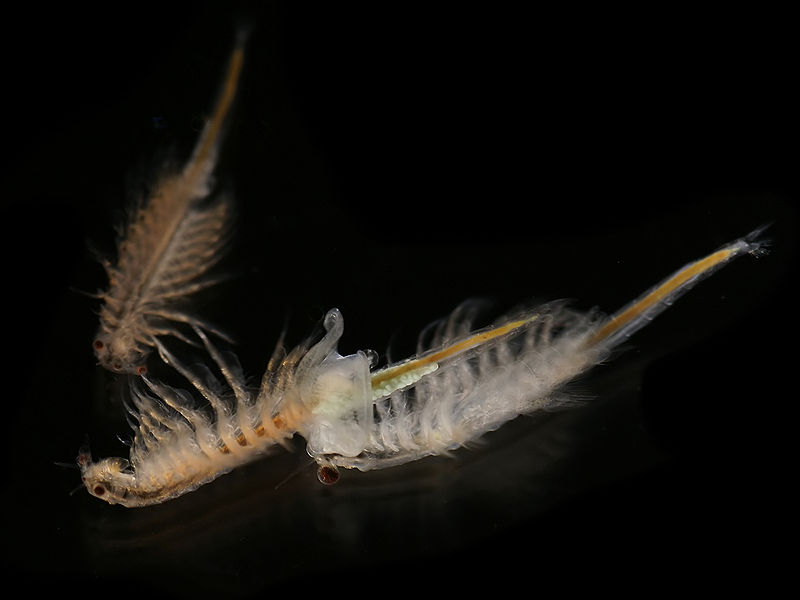
- The real name for this species is Artemia a.k.a Brine Shrimp which is a genus of Aquatic Crustaceans.
- The total length is usually about 8 millimetres (0.31 in)-10 millimetres (0.39 in) for the adult male and 10 millimetres (0.39 in)-12 millimetres (0.47 in) for the female, but the width of both sexes, including the legs, is about 4 millimetres (0.16 in)
- Harold von Braunhut first invented and introduced these Sea-Monkeys based on Brine Shrimp in 1957.
- It does not feed but consume their own energy reserves stored in the cyst while wild Brine Shrimps eats microscopic Planktonic-Algae.
- Cultured Brine Shrimps can also be fed particulate foods including yeast, wheat flour, soybean powder or egg yolk.
- These creatures undergo Cryptobiosis ( an ametabolic state of life entered by an organism in response to adverse environmental conditions such as desiccation, freezing, and oxygen deficiency) – often sold in hatching kits as novelty aquarium pets.
- All metabolic procedures stop, preventing reproduction, development, and repair during this period. An organism in a Cryptobiotic state can essentially live indefinitely until environmental conditions return to being hospitable. When this occurs, the organism will return to its metabolic state of life as it was prior to the Cryptobiosis.
- While in Cryptobiosis, Brine Shrimp eggs can survive temperatures of liquid air (−190 °C or −310.0 °F) and a small percentage can survive above boiling temperature (105 °C or 221 °F) for up to two hours. Once placed in briny (salt) water (>5‰), the eggs hatch within a few hours. The nauplii, or larvae, are less than 0.4 mm in length when they first hatch. Brine Shrimps has a biological life cycle of one year.
Okay, so... NOW.... YOU KNOW. hahhaha. not to hypnotize/brainwashing you to not buy these things. Just for information. Knowledge is very important to a person. It reflects the personality of his/her. Yes, they are cute in figure but might not be a fortune worth wasting for unless you just love these things and not to worry of paying a sum of money continuously to keep them as pets. Rather buy a real pet like cats, dogs, birds, iguana or wtv it is than this. love and care them better. though, it's not so expensive... it's just can be considered as wasteful and un-useful item to keep. well, i'm not the judge here. i'm just here to give information. I, personally don't have a problem in keeping them. quite easy but might think twice about the regular costs. lol :D